Science labs should feel approachable, doable, and actually enjoyable, even if you don’t have a full lab setup or years of experience running experiments. I’ve taught in classrooms without sinks, with wild class periods, and with barely enough materials to go around. I know how intimidating labs can feel when the logistics seem overwhelming.
That’s why I create labs that are simple to prep, easy to run, and realistic for real classrooms—whether you’re a first-year teacher or a seasoned pro. My goal is to take the stress out of labs so you can focus on what matters most: helping your students explore, question, and fall in love with science.
Let’s make hands-on learning possible for everyone with this Egg Osmosis Lab. No fancy equipment required. You’ve got this, and I’m here to help.
Egg Osmosis Lab Summary
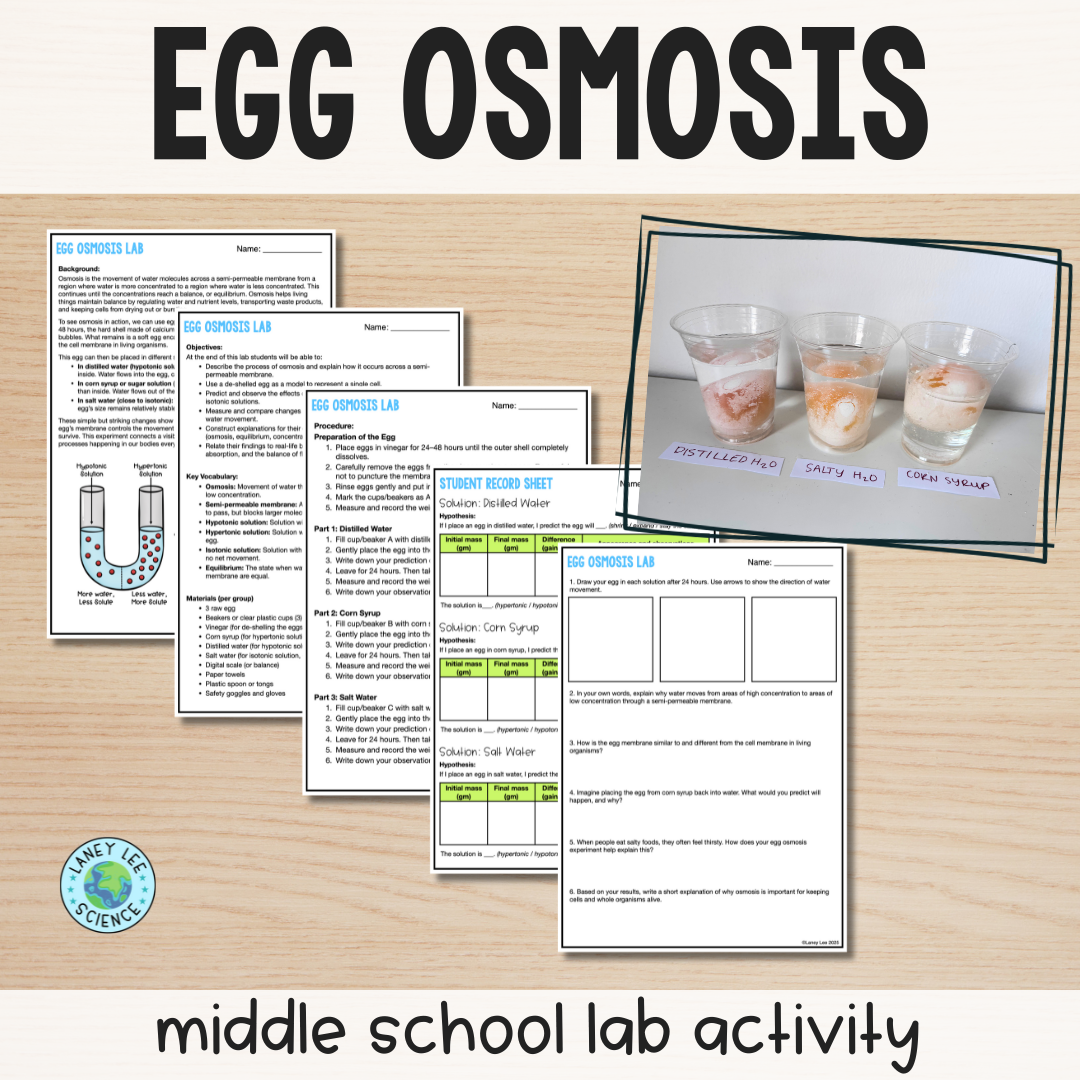
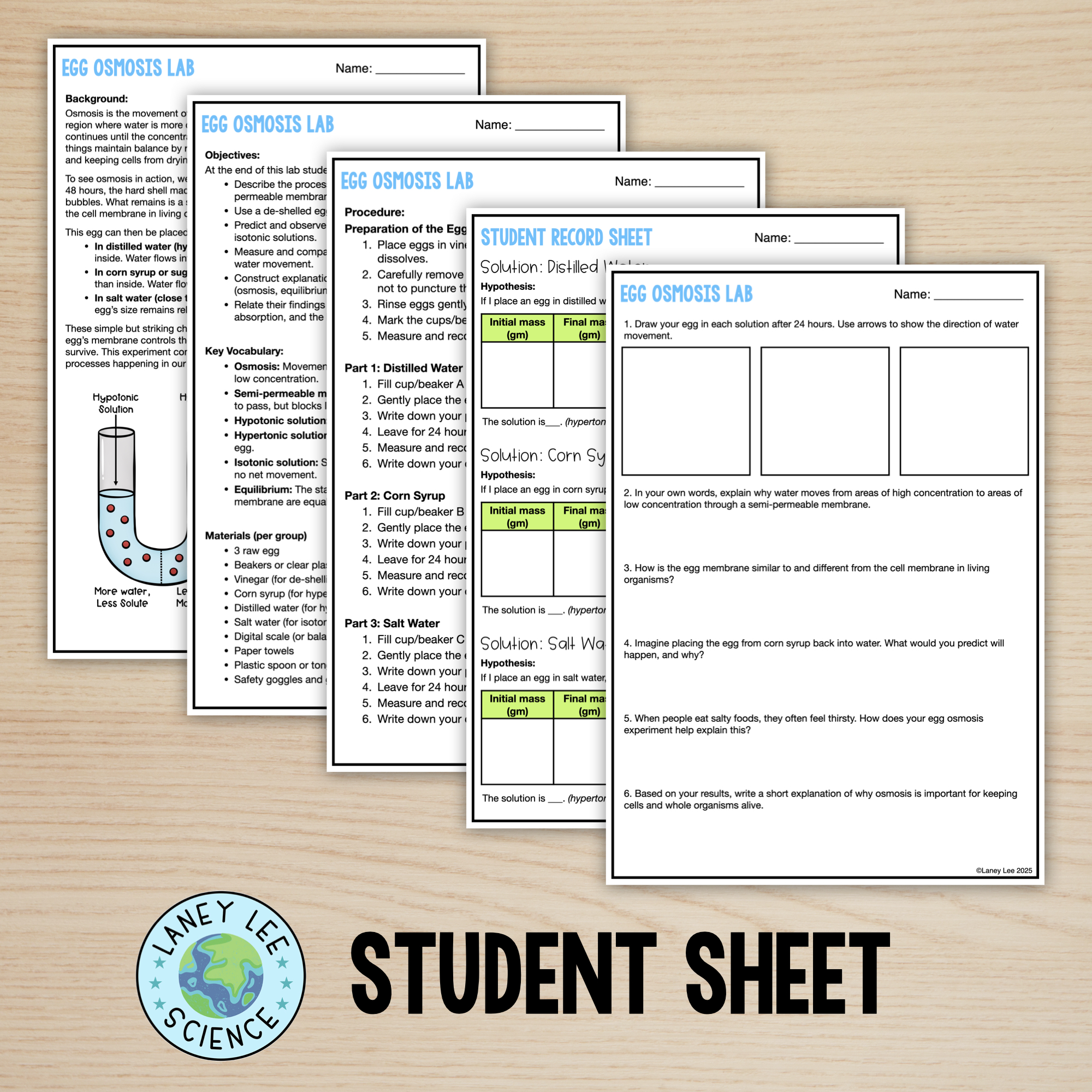
In the egg osmosis lab, students use a de-shelled egg to model how water moves across a semi-permeable membrane. After soaking raw eggs in vinegar to remove the shells, each egg is placed in a different solution (distilled water, corn syrup, and salt water) for 24 hours. Students measure changes in the egg’s mass and appearance to observe osmosis in action: the egg swells in hypotonic distilled water as water flows in, shrinks in hypertonic corn syrup as water flows out, and remains nearly unchanged in isotonic salt water. This simple, visual experiment clearly demonstrates how cells regulate water balance and maintain homeostasis.
See more of this lab in action on my blog.
Who is this Egg Osmosis Lab resource for?
Ideal for grades 6–9, this resource supports classroom teachers, tutors, homeschoolers, and parents alike. It’s designed to work across a variety of instructional settings.
What’s Included?
- PDF file (ready to print!)
- Google Slides version for digital assignment
- Plain text Google Doc (easy to translate)
- Editable PPT/Keynote version
- Answer Key
Everything you need is just a click away. After purchase, download the main PDF and access all linked digital resources on page 2.
Please look at the preview file to see more of this resource.
More questions?
Email me at laneyleeteaches@gmail.com.