Do your students glaze over during reading time?
Struggling with vocabulary retention?
Noticing shorter and shorter attention spans year after year?
If you’re nodding “yes” to any of these, this resource is here to save the day!
Reading comprehension doesn’t have to be boring or overwhelming—and it doesn’t belong only in the ELA classroom! Every teacher can support literacy with the right tools (and a little bit of fun!). Just model, read together, annotate, and let those meaningful discussions begin!
I created this line of reading resources to make your life easier and your students more confident readers.
Each passage is:
- ✔️ Clear and engaging
- ✔️ Written at a grade 6–8 reading level
- ✔️ Paired with thoughtful, rigorous questions that ask students to predict, reflect, connect, and think critically
Whether you’re using it for pre-reading, homework, review, or to support absent students—this resource has the flexibility you need to fit your teaching style.
Let’s get those students reading, writing, and building vocabulary—without all the prep stress!
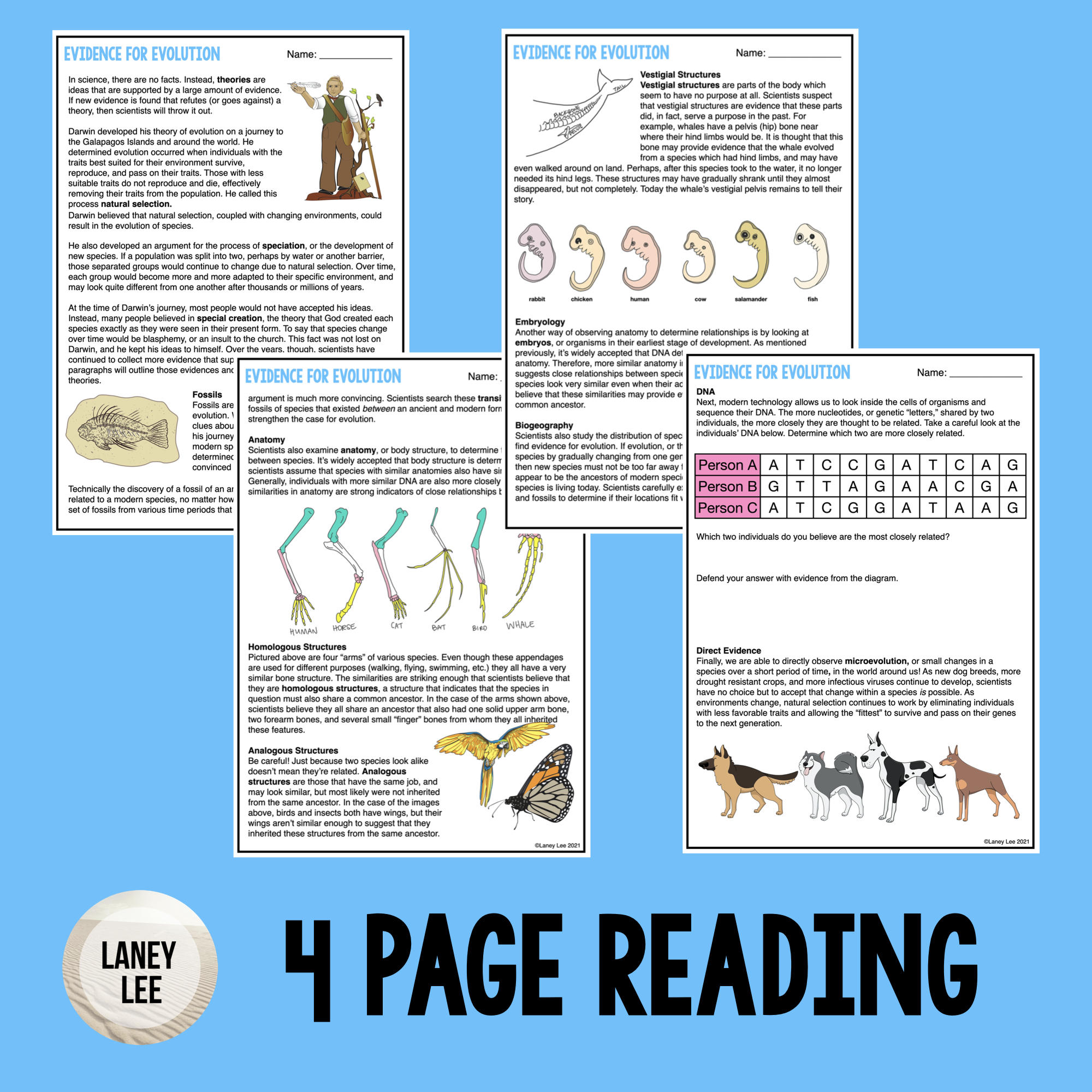
Topics covered in this evidence for evolution worksheet include:
- Darwin & natural selection
- fossils
- anatomy: homologous structures, analogous structures, vestigial structures, and embryology
- biogeography
- DNA evidence
- direct observation
Who is this resource for?
Ideal for grades 6–9, this resource supports classroom teachers, tutors, homeschoolers, and parents alike. It’s designed to work across a variety of instructional settings.
How Can I Use this Resource?
- Emergency sub plans
- Flipped classroom pre-reading
- Whole/small group modeling of close reading
- Independent workstations or homework
- Extension activities for early finishers
- Choice boards
- Interactive notebooks (mini-booklet or annotation style)
- Reteaching for students needing extra support
- Make-up work for absent students
What’s Included?
- PDF file (ready to print!)
- Audio version
- Google Slides version for digital assignment
- Plain text Google Doc (easy to translate)
- Editable PPT/Keynote version
- Answer Key
Everything you need is just a click away. After purchase, download the main PDF and access all linked digital resources on page 2.
Please look at the preview file to see more of this resource.
What’s Next?
If you enjoy this resource, consider checking out some of my other guided readings! Or submit a request for a topic you’d like to see in a future product.
More questions?
Check out our Frequently Asked Questions or email me at laneyleeteaches@gmail.com.
———————————————————————————————————–
Get more value by becoming a member! 
Join our membership to gain access to my entire catalog of resources for FREE!
My store features 3 full-year middle school science curriculums comprised of over 22 units of study.
Each and every unit comes includes the following:
- A unit guide complete with key vocabulary, suggested pacing, essential questions, and more!
- Google Slides presentations to cover major topics, with guided notes for students!
- Reading Comprehension activities with follow up questions. These resources are useful for homework, classwork, sub plans, and more!
- Assessment: Pretest, study guide, CERs, and final assessment.
- Projects and labs
- Webquests, color by number, stations, and other practice activities.
Click below to learn more about how to sign up!
Join monthly.
Join yearly.
———————————————————————————————————–
NGSS Standards covered by this Evidence for Evolution Worksheet:
MS-LS4-1 Analyze and interpret data for patterns in the fossil record that document the existence, diversity, extinction, and change of life forms throughout the history of life on Earth under the assumption that natural laws operate today as in the past. Emphasis is on finding patterns of changes in the level of complexity of anatomical structures in organisms and the chronological order of fossil appearance in the rock layers. Assessment does not include the names of individual species or geological eras in the fossil record.
MS-LS4-2 Apply scientific ideas to construct an explanation for the anatomical similarities and differences among modern organisms and between modern and fossil organisms to infer evolutionary relationships. Emphasis is on explanations of the evolutionary relationships among organisms in terms of similarity or differences of the gross appearance of anatomical structures.
MS-LS4-3 Analyze displays of pictorial data to compare patterns of similarities in the embryological development across multiple species to identify relationships not evident in the fully formed anatomy. Emphasis is on inferring general patterns of relatedness among embryos of different organisms by comparing the macroscopic appearance of diagrams or pictures. Assessment of comparisons is limited to gross appearance of anatomical structures in embryological development.
MS-LS4-4 Construct an explanation based on evidence that describes how genetic variations of traits in a population increase some individuals’ probability of surviving and reproducing in a specific environment. Emphasis is on using simple probability statements and proportional reasoning to construct explanations.
HS-LS4-1 Communicate scientific information that common ancestry and biological evolution are supported by multiple lines of empirical evidence. Emphasis is on a conceptual understanding of the role each line of evidence has relating to common ancestry and biological evolution. Examples of evidence could include similarities in DNA sequences, anatomical structures, and order of appearance of structures in embryological development.