Do your students glaze over during reading time?
Struggling with vocabulary retention?
Noticing shorter and shorter attention spans year after year?
If you’re nodding “yes” to any of these, this resource is here to save the day!
Reading comprehension doesn’t have to be boring or overwhelming—and it doesn’t belong only in the ELA classroom! Every teacher can support literacy with the right tools (and a little bit of fun!). Just model, read together, annotate, and let those meaningful discussions begin!
I created this line of reading resources to make your life easier and your students more confident readers.
Each passage is:
- ✔️ Clear and engaging
- ✔️ Written at a grade 6–8 reading level
- ✔️ Paired with thoughtful, rigorous questions that ask students to predict, reflect, connect, and think critically
Whether you’re using it for pre-reading, homework, review, or to support absent students—this resource has the flexibility you need to fit your teaching style.
Let’s get those students reading, writing, and building vocabulary—without all the prep stress!
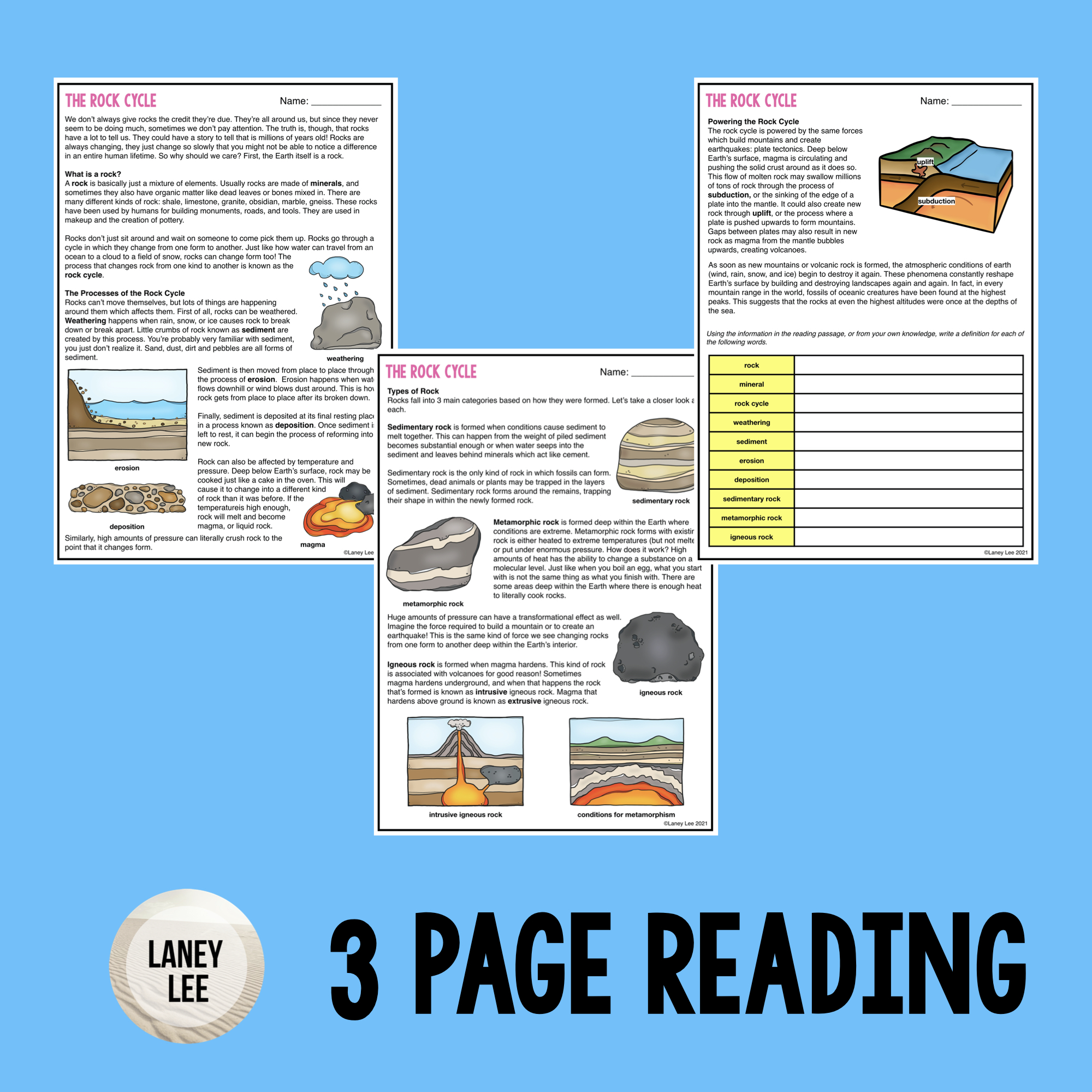
Topics covered in this Rock Cycle worksheet include:
- rock types: sedimentary, igneous, metamorphic
- major processes involved in the rock cycle
- phenomena which drive the rock cycle
Who is this resource for?
Ideal for grades 6–9, this resource supports classroom teachers, tutors, homeschoolers, and parents alike. It’s designed to work across a variety of instructional settings.
How Can I Use this Resource?
- Emergency sub plans
- Flipped classroom pre-reading
- Whole/small group modeling of close reading
- Independent workstations or homework
- Extension activities for early finishers
- Choice boards
- Interactive notebooks (mini-booklet or annotation style)
- Reteaching for students needing extra support
- Make-up work for absent students
What’s Included?
- PDF file (ready to print!)
- Audio version
- Google Slides version for digital assignment
- Plain text Google Doc (easy to translate)
- Editable PPT/Keynote version
- Answer Key
Everything you need is just a click away. After purchase, download the main PDF and access all linked digital resources on page 2.
Please look at the preview file to see more of this resource.
What’s Next?
If you enjoy this resource, consider checking out some of my other guided readings! Or submit a request for a topic you’d like to see in a future product.
More questions?
Email me at laneyleeteaches@gmail.com
NGSS Standards covered by this Rock Cycle Worksheet:
MS-ESS2-1 Develop a model to describe the cycling of Earth’s materials and the flow of energy that drives this process. Emphasis is on the processes of melting, crystallization, weathering, deformation, and sedimentation, which act together to form minerals and rocks through the cycling of Earth’s materials. Assessment does not include the identification and naming of minerals.
MS-ESS2-2 Construct an explanation based on evidence for how geoscience processes have changed Earth’s surface at varying time and spatial scales. Emphasis is on how processes change Earth’s surface at time and spatial scales that can be large (such as slow plate motions or the uplift of large mountain ranges) or small (such as rapid landslides or microscopic geochemical reactions), and how many geoscience processes (such as earthquakes, volcanoes, and meteor impacts) usually behave gradually but are punctuated by catastrophic events. Examples of geoscience processes include surface weathering and deposition by the movements of water, ice, and wind. Emphasis is on geoscience processes that shape local geographic features, where appropriate.