I'm an international teacher in Abu Dhabi. I am seeking new ways to support teachers. I am the face behind the Laney Lee science resources that you love!
Let me be real: I’ve taught middle school science in classrooms where chaos was the norm—behavior issues, no designated lab space, and not nearly enough time. The idea of prepping a multi-solution lab on a tight schedule? Absolutely overwhelming.
That’s exactly why I started creating science labs that are simple, engaging, and realistic for everyday classrooms.
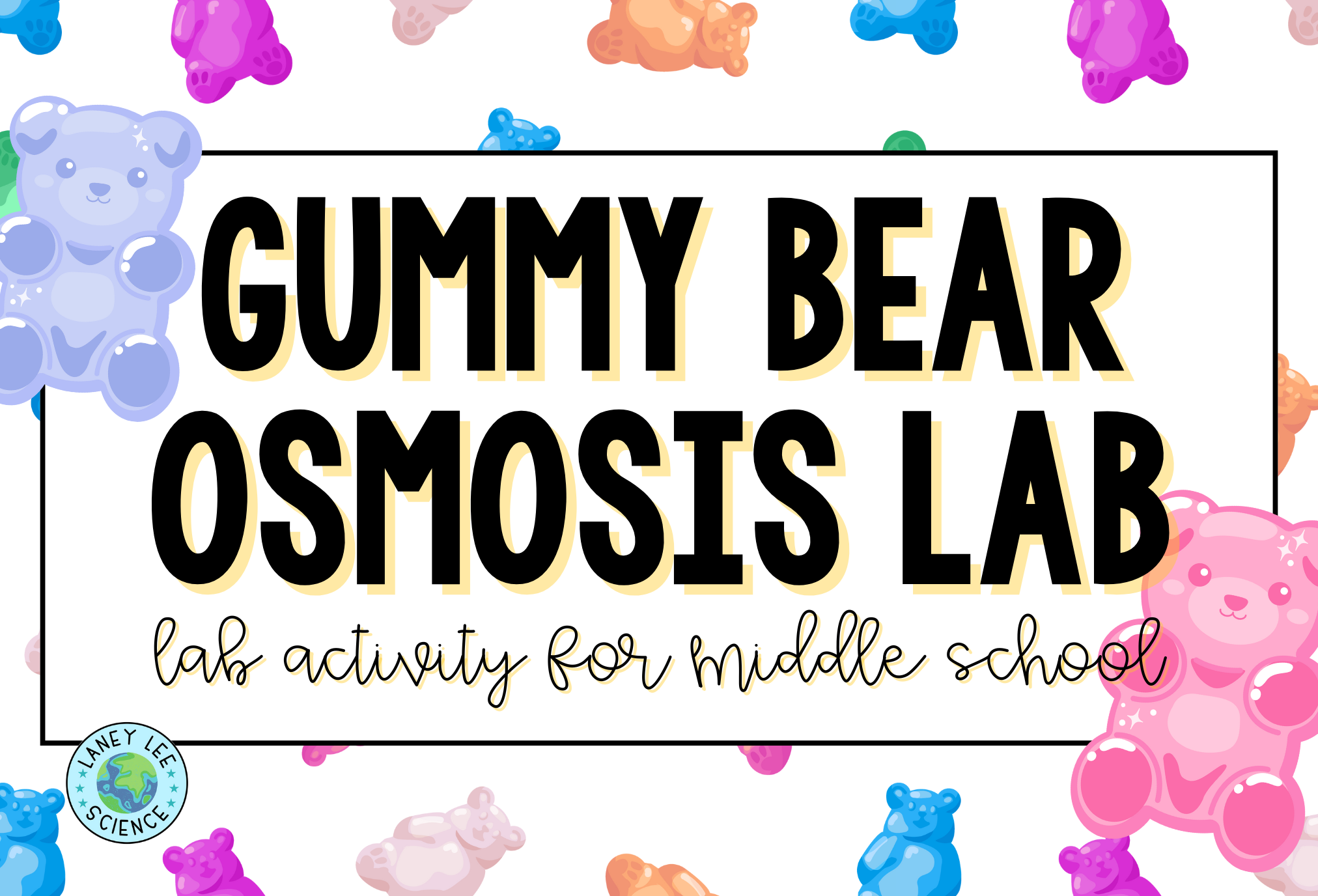
This gummy bear osmosis lab is one of my favorites because it takes a tricky, abstract concept—osmosis—and turns it into a visual, measurable, hands-on investigation that students love. Using gummy bears as models of real cells, students explore how water moves across a selectively permeable membrane, how solute concentration affects cell structure, and why cells change shape depending on their environment.
Not only does this activity align beautifully with NGSS MS-LS1-2 and MS-LS1-3, it also supports data collection, analysis, pattern recognition, and evidence-based explanation. Students predict, observe, measure, and compare results across multiple solutions, building deep conceptual understanding through real, observable outcomes.
And best of all? It’s totally teacher-friendly—low prep, low cost, and easy to run even in the most unpredictable classroom environment.
Each group tests five gummy bears, one in each solution:
Distilled water
Salt water
Vinegar
Corn syrup solution
Baking soda solution
Plus: containers, rulers, digital scale, spoons, paper plates, safety goggles, paper towels, and labeling supplies.
PROCEDURE SUMMARY
Step 1: Prep the Bears Students label their bears (A–E), measure mass and dimensions, and record all starting data.
Step 2: Prepare the Solutions Each container gets the correct liquid or solute/water mixture—distilled water, salt, vinegar, baking soda, and corn syrup solution.
Step 3: Soak for 24–48 Hours Each gummy bear is submerged in its solution and left undisturbed.
Step 4: Observe and Measure After soaking, students remove the bears, record appearance changes, and remeasure mass, length, width, and depth.
Step 5: Analyze Osmosis Using before-and-after data, students determine whether water entered the bear, left the bear, or stayed the same. They then explain their reasoning using vocabulary like osmosis, concentration, solute, solvent, and selectively permeable membrane.
Laney’s Tips for Success
Use a class data table. Combining results helps students clearly see patterns across solutions.
Stress predictions before testing. This builds strong argument-from-evidence skills when results come in.
Remind students to handle the bears gently. After soaking, they can be extremely fragile.
Extend the discussion. Tie in real-world examples like dehydration, plant watering, or sports drinks to make osmosis meaningful.
CONCLUSION
The gummy bear osmosis lab is an unforgettable way to help students visualize how water moves across membranes and why cells change shape in different environments. By soaking gummy bears in a variety of solutions and comparing data, students gain a clear, evidence-based understanding of osmosis, and they have fun doing it. Whether you’re introducing cell transport or reviewing before an assessment, this lab brings life science concepts to life in a simple, accessible, high-impact way.