I'm an international teacher in Abu Dhabi. I am seeking new ways to support teachers. I am the face behind the Laney Lee science resources that you love!
Let me be real: I’ve taught middle school science in classrooms where chaos was the norm—behavior issues, no designated lab space, and barely enough time to get through the essentials. Trying to teach a concept as big as natural selection in a way students actually understand? That used to feel impossible.
That’s exactly why I started creating science labs that are simple, engaging, and realistic for everyday classrooms.
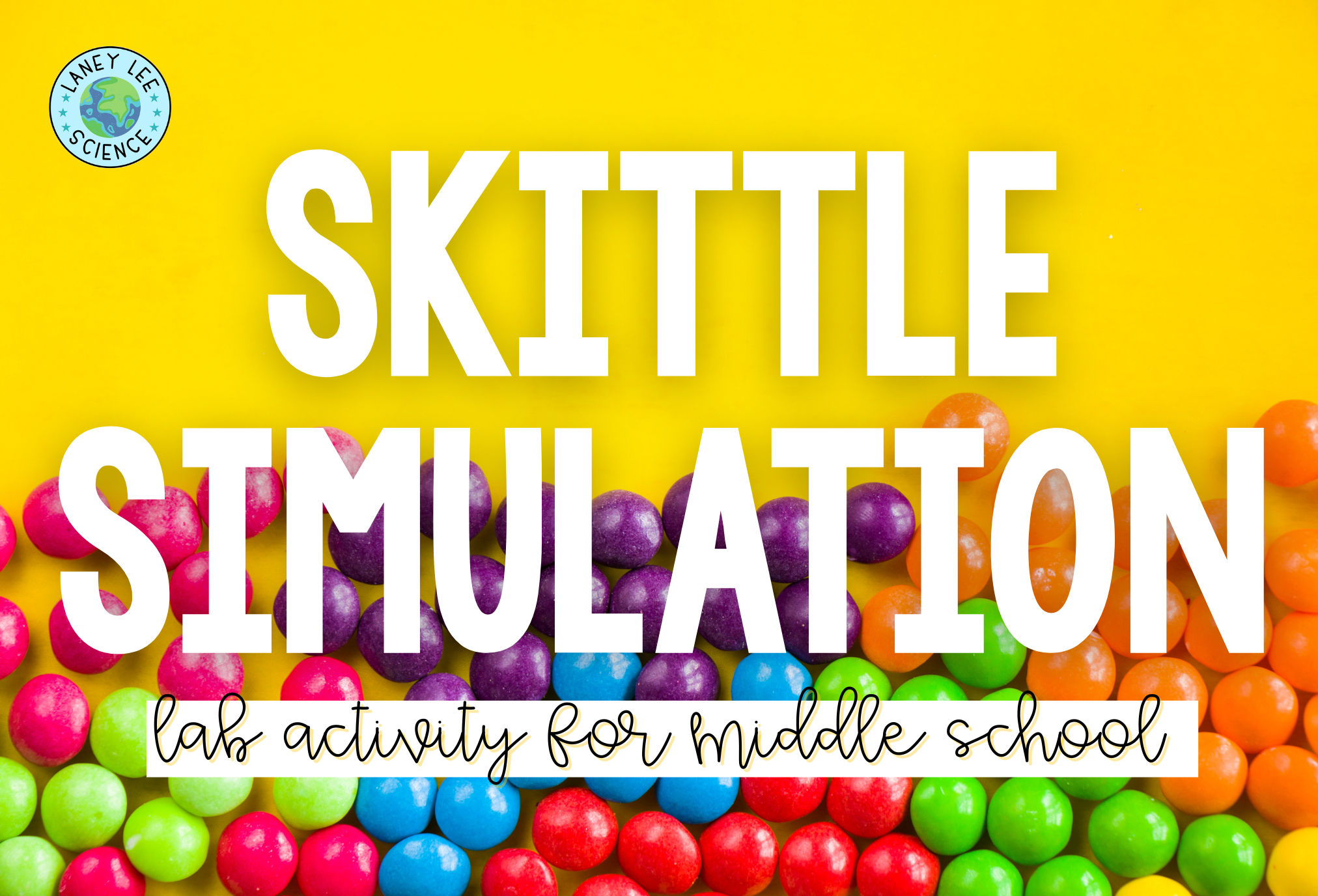
This Skittle Simulation Lab is one of my favorite ways to teach natural selection because it is easy to run, highly visual, data-rich, and surprisingly powerful. With nothing more than colored Skittles, paper “habitats,” and a predator with poor eyesight (aka a student in sunglasses!), learners model how variations in traits affect survival and reproduction over multiple generations.
Not only does this activity align beautifully with NGSS MS-LS4-4 and MS-LS4-6, it gives students a hands-on way to see how populations change over time. They record data, graph population shifts, identify patterns, and build real explanations for why certain traits increase, decrease, or even go extinct.
And the best part? It’s fun, fast, and teacher-friendly—no prep beyond opening a bag of Skittles.
Step 1: Set Up the Habitat Students place 20 Skittlefish on an orange paper reef and record the starting population.
Step 2: Make Predictions Before hunting, they predict which colors will survive best and which will be easiest to spot.
Step 3: Predation Round Wearing sunglasses in dim lighting, “Seabird predators” remove the five most visible Skittlefish from the reef.
Step 4: Reproduction Surviving Skittlefish reproduce—each survivor creates one identical offspring—returning the population to 20.
Step 5: Repeat for 5 Generations Students track how the number of each color changes and then graph the population trends.
Step 6: Run the Simulation Again in a Different Habitat Students repeat the entire investigation on a green paper reef and compare the results.
Step 7: Discuss & Explain Learners answer post-lab questions that connect camouflage, variation, adaptation, and natural selection to real ecosystems.
Laney’s Tips for Success
Dim the lights more than you think. It drastically improves the camouflage effect.
Remind students to be consistent hunters. “Choose the easiest to see,” not “choose randomly.”
Have graph paper ready. Graphing each habitat helps students see evolution unfold.
Emphasize survival AND reproduction. Many kids forget that surviving alone isn’t enough. The survivors must reproduce to pass on traits.
Run a classwide discussion after both habitats. It’s a perfect moment to compare selective pressures and environmental differences.
CONCLUSION
The Skittle Simulation Lab brings natural selection to life in the most accessible, engaging way possible. Students watch real data unfold as they model how camouflage, variation, and selective pressure shape populations over time, and they walk away with a deep, memorable understanding of evolution. Whether you’re introducing adaptation, reviewing for a test, or looking for a powerful NGSS-aligned lesson, this lab delivers every single time.